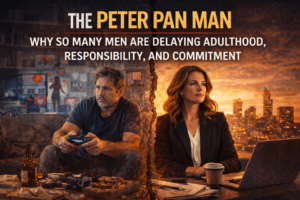

A growing number of women say they can’t find men who are ready for real relationships.
A growing number of men say they feel lost in a world that no longer needs them.
Somewhere between the rise of dating apps, the transformation of gender roles, and the explosion of digital entertainment, a new cultural figure quietly emerged:
The Peter Pan Man.
He’s not necessarily a bad person.
He may be funny, charming, intelligent, and even successful in certain areas of life.
But when it comes to relationships, responsibility, and long-term commitment, he often seems stuck in a prolonged state of adolescence.
Many women in their 30s, 40s, and even 50s describe encountering the same pattern repeatedly.
Men who seem unwilling to settle down.
Men who avoid emotional responsibility.
Men who prefer comfort, entertainment, and independence over partnership.
While this dynamic is often discussed casually in dating conversations, the underlying causes are far more complex.
The “Peter Pan Man” phenomenon may be the result of deep cultural shifts affecting modern masculinity.
A Generation Without a Clear Script
For most of modern history, adulthood followed a relatively predictable sequence.
Men were expected to:
finish school
start a career
marry
start a family
take on responsibility
These milestones served as markers of maturity.
They also gave men a clear sense of identity and purpose.
But over the past several decades, many of these expectations have weakened.
Marriage now happens later—or sometimes not at all.
Many adults live independently longer.
Career paths are less predictable.
And cultural messages around masculinity have become more ambiguous.
Without clear milestones guiding the transition from boyhood to manhood, some men drift.
They delay decisions.
They postpone responsibility.
They remain in a kind of extended adolescence.
The Dopamine Economy
Another powerful force shaping modern male behavior is what psychologists sometimes call the dopamine economy.
Never in human history have people had such immediate access to stimulation and entertainment.
Video games offer endless achievement loops.
Social media provides constant validation.
Streaming platforms supply unlimited entertainment.
Online pornography creates instant gratification.
These systems are designed to trigger dopamine—the brain’s reward chemical.
While these technologies affect everyone, research suggests they may impact young men particularly strongly.
Many of the activities that once pushed men toward real-world achievement—career advancement, competition, social status—have digital substitutes.
Instead of building status through career success or relationships, some men receive similar psychological rewards through gaming, online communities, or digital attention.
This can make real-life responsibilities feel less urgent.
The Avoidance of Risk
Relationships require vulnerability.
They require emotional investment.
They require the possibility of rejection, disappointment, or failure.
For some men, modern dating feels increasingly high-risk.
Cultural expectations have changed rapidly.
Approaching women can feel uncertain.
Traditional male roles are less defined.
Some men respond by avoiding the situation altogether.
Instead of risking rejection or misunderstanding, they focus on areas of life that feel safer and more predictable.
Work.
Hobbies.
Online worlds.
Distraction.
While this avoidance may provide short-term comfort, it can create long-term loneliness.
The Success Gap
Another factor influencing the Peter Pan phenomenon is the widening gap between male and female educational outcomes.
Women now graduate from college at significantly higher rates than men.
This has created a growing divide in career paths and economic stability.
Some men who struggle academically or professionally may feel intimidated by highly successful women.
Instead of stepping up to compete in those environments, some withdraw.
They seek spaces where expectations feel lower and success feels easier.
Unfortunately, this dynamic can reinforce the very problem many women describe: a shortage of men who appear driven, mature, and relationship-ready.
The Loneliness Problem
Ironically, the Peter Pan lifestyle does not necessarily produce happiness.
Research increasingly shows that men report higher rates of loneliness and social isolation than women.
Many men struggle to maintain close friendships in adulthood.
Without strong social networks or committed partnerships, emotional isolation can grow over time.
What begins as freedom can slowly turn into disconnection.
Many men eventually reach a point where they want deeper relationships but feel unsure how to build them.
The Cultural Conversation Around Masculinity
The Peter Pan phenomenon is also connected to a broader cultural conversation about masculinity.
Over the past two decades, masculinity has often been framed primarily in terms of its negative expressions—aggression, dominance, or toxicity.
While addressing harmful behavior is important, the conversation sometimes leaves young men without positive models for healthy masculinity.
Healthy masculinity might include:
responsibility
leadership
emotional strength
protectiveness
commitment
Without visible examples of these traits being valued, some men struggle to understand what adulthood is supposed to look like.
And when purpose becomes unclear, motivation can fade.
Why This Frustrates Women
For many women—especially those who have worked hard to build careers, emotional maturity, and independence—encountering Peter Pan behavior can be deeply frustrating.
They want partnership.
They want stability.
They want emotional presence.
But instead they often encounter men who seem hesitant to grow up.
This mismatch between female maturity and male hesitation can create enormous tension in the dating world.
It reinforces the perception that responsible, emotionally available men are increasingly rare.
The Possibility of Growth
Despite these challenges, the Peter Pan narrative is not destiny.
Many men eventually reach turning points that push them toward growth.
Career ambition.
Meaningful relationships.
Fatherhood.
Personal purpose.
These experiences can transform a man’s sense of identity and responsibility.
When men find a compelling reason to step into adulthood, many do so with remarkable strength.
The Bigger Picture
The rise of the Peter Pan Man is not simply about laziness or immaturity.
It reflects deeper cultural forces:
changing gender roles
digital distraction
educational gaps
uncertain expectations around masculinity
Understanding these forces helps explain why modern dating sometimes feels so confusing.
Men and women are navigating a world where the old scripts no longer apply—and the new ones are still being written.
But the story does not end here.
Another powerful force shaping modern relationships is technology itself.
Dating apps, social media, and algorithm-driven platforms have fundamentally changed how people meet, evaluate, and choose partners.
In the next article in this series, we’ll explore how dating apps transformed romance into a gamified marketplace—and why that shift may be making real connection harder to find.