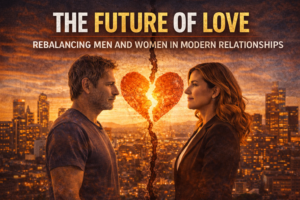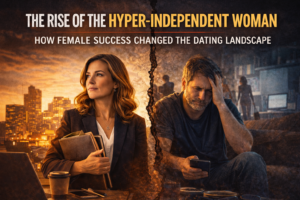

After decades of cultural upheaval, men and women may be entering a new phase of relationships.
Not a return to the past—but a search for balance.
Over the past half century, the relationship between men and women has undergone one of the most dramatic transformations in human history.
Women entered universities in record numbers.
They built careers, gained financial independence, and expanded opportunities that previous generations could only imagine.
At the same time, traditional expectations for men shifted dramatically. The roles that once defined masculinity—provider, protector, leader—became less clearly defined in modern society.
Technology then added another layer of disruption. Dating apps, social media, and digital culture transformed how people meet, evaluate, and choose partners.
The result has been a confusing new landscape where both men and women often feel uncertain about how relationships are supposed to work.
Yet beneath all this change, one truth remains remarkably constant:
Most people still want love, companionship, and partnership.
The question now is what those partnerships will look like in the future.
The End of the Old Relationship Model
For much of the twentieth century, relationships followed a relatively predictable structure.
Men provided financial stability.
Women managed households and family life.
Marriage happened early, often in people’s twenties, and the economic survival of the household depended on cooperation between the two partners.
That model worked for many families, but it also restricted women’s independence and opportunities.
Today, that structure has largely disappeared.
Women no longer rely on men for economic survival.
Careers, education, and financial independence have changed the foundation of relationships.
Marriage is no longer a necessity—it is a choice.
And when relationships become a choice rather than a requirement, expectations tend to evolve.
The Rise of Partnership-Based Relationships
The future of relationships is likely to be built less on economic dependency and more on mutual partnership.
In modern relationships, both individuals often bring similar strengths to the table:
careers
education
financial stability
emotional intelligence
Rather than one partner providing while the other supports, couples increasingly build lives as collaborative teams.
Some sociologists refer to this model as the “power couple” dynamic.
In these relationships, both individuals maintain independence while also supporting each other’s ambitions and growth.
This shift represents a profound change from earlier generations.
Relationships become less about survival and more about shared purpose.
The Rediscovery of Complementarity
However, equality does not mean sameness.
One of the emerging conversations in modern relationship psychology involves the concept of complementarity.
Men and women may both be capable, intelligent, and independent, but they often bring different emotional and psychological strengths to relationships.
Healthy partnerships tend to emerge when those differences complement rather than compete with each other.
For example:
One partner may naturally lead in certain areas of life.
The other may excel in emotional communication.
One may focus on long-term strategic thinking.
The other may prioritize social connection and community.
When these strengths combine effectively, relationships can become stronger than either partner individually.
Complementarity does not mean hierarchy.
It means synergy.
A Healthier Vision of Masculinity
Another critical element in the future of relationships is the evolution of masculinity itself.
For many years, cultural conversations around masculinity focused primarily on its negative expressions—aggression, dominance, or toxic behavior.
While addressing harmful behavior is essential, healthy masculinity also includes positive traits that many relationships rely on:
responsibility
leadership
discipline
protectiveness
loyalty
Many women still value these qualities in partners.
The challenge is helping men understand that these traits can exist in modern relationships without conflicting with women’s independence.
Healthy masculinity is not about controlling or overshadowing women.
It is about showing up with strength, reliability, and purpose.
A Healthier Vision of Feminine Strength
At the same time, the rise of strong, independent women has expanded the definition of femininity.
Modern femininity can include ambition, leadership, intellectual achievement, and independence.
But many women also still value emotional intimacy, connection, and partnership.
Strength does not eliminate the desire for love.
Independence does not eliminate the desire to share life with someone.
The future of relationships may involve women embracing both independence and relational connection without feeling that one contradicts the other.
The Role of Technology in the Future of Dating
Technology will continue to influence relationships in powerful ways.
Dating apps are unlikely to disappear, but their role may evolve.
Many people are already experiencing fatigue with swipe-based dating culture.
The endless cycle of options, comparisons, and short interactions can create emotional burnout.
Future dating platforms may focus more on compatibility, shared interests, and meaningful connection rather than quick visual judgments.
Offline social networks—community groups, professional circles, shared activities—may also become more important again.
Human beings evolved to form relationships through shared environments, not endless digital menus.
The Return of Intention
Perhaps the most important change in the future of relationships will be the return of intentional dating.
Instead of passively browsing endless options, many people are beginning to approach relationships with greater clarity.
They ask questions like:
What kind of partnership do I want?
What values matter most to me?
What kind of life do I want to build with someone else?
This shift toward intentionality may help people form deeper, more stable connections.
When both partners approach relationships with purpose rather than convenience, commitment becomes more meaningful.
The Possibility of Balance
Despite all the frustrations people often feel about modern dating, there are reasons to be optimistic.
Men and women today have more freedom than any generation before them.
They can choose partners based on compatibility rather than necessity.
They can build relationships that reflect shared values rather than rigid social expectations.
This freedom creates complexity—but it also creates opportunity.
The future of love may not resemble the past.
But it may ultimately produce partnerships that are more authentic, more balanced, and more fulfilling.
The Next Chapter
The dating crisis many people feel today may simply be the growing pains of a society in transition.
Old relationship models have disappeared.
New ones are still forming.
Men and women are learning how to navigate independence, ambition, and connection all at the same time.
It will take time for culture to adjust.
But the desire for partnership remains deeply human.
People still want someone to laugh with, grow with, and build a life beside.
And as society continues to evolve, men and women may gradually rediscover how their strengths can work together rather than against each other.
Not in competition.
But in balance.
Because the future of relationships will not be defined by which gender wins.
It will be defined by how well we learn to meet each other again.